(001) Shelley Burgon — LOVEHER (002) Che Chen — Bus Passes By / Saturday (003) Brian Chase — Ride / Scratch (004) Nathan Liow & Angus Tarnawsky — Artifacts (005) Daren Ho — 1 2 3 4 5 6 (006) monotope — Unsteady Scaffold / Voltaire’s Dubs (007) Thomas Kircher & Lukas Grundmann — Wider / Wieder (008) Joe Talia — Sayu / Volo a Vela (009) Shelley Burgon — LOVEHER (2014) (010) Angus Tarnawsky — Surface To Air (011) Robert Deeds (Curated by Maria Chavez) — Broken Piano (012) Bryce Hackford — Diegetic Music (013) Victoria Keddie — Cannibal Mécanique (014) Brian Chase & Angus Tarnawsky — Live At Secret Project Robot (015) Brian Chase — Drums & Drones II (016) 1000 Petal Lotus & Angus Tarnawsky — Subconscious Self Sabotage (017) JAB — The Gallop

001
Shelley Burgon
LOVEHER
10” lathe cut record
Edition of 25 copies
2013
Shelley Burgon is a harpist and sound artist based in New York. Her musical work centers around the sound of the harp, both as a traditional acoustic instrument in a chamber setting and as the primary source for her electronic music. Her sound art focuses on handmade electronic sculptures that combine scientific theories and mysticism. For ICM001, Shelley recorded prepared harp in conjunction with computer processing. The resulting 11 minute piece titled LOVEHER is one live take with no editing or mixing.
Shelley received her MFA in Electronic Music from Mills College and studied with Pauline Oliveros, Fred Frith, Alvin Curran and Maryanne Amacher. She has performed and recorded the music of artists including Bjork, Zeena Parkins, Anthony Braxton, John Zorn, Butch Morris, Miho Hatori (Cibo Matto), Christian Marclay, Joan LaBarbara, Elliott Sharp and Maria Chavez in addition to performing with bands such as Stars Like Fleas, Elysian Fields and Blondes. Her first sound and light installation was shown in 2013 at The New Museum’s Ideas City Festival and Frieze Art Week.
PRESS
(1)
Thousands of little vulnerable crystal fronds swing, imperiled by inchoate doom, from the lid of a jewelry box, and at my count only two dozen of you are fortunate enough to hear it. Focused in presentation but diffuse and chilling in actual sound, this new work finds NYC harpist/improviser Shelley Burgon running her instrument through electronic processing to create a cold, frostbitten stream of high-register, textural notes gliding past slowly in a continuous cluster, as tones fall out with regular drip-drop intervals and passing clicks turn into reverberated percussives. (Doug Mosurock, Still Single)
(2)
Electro-acoustic music can verge on the cold/clinical, but LOVEHER couldn’t be any less so. Its slow ascent from a fragment of an idea to a fully bloomed bud is reminiscent of a sun rising or a planet orbiting, slow and reassuring, as inevitable as the tides. A few of the sequences are eerily redolent of soundtrack work you’ll barely realize you’re hearing as you watch films, but Burgon inhabits a space all her own. She is to her harp what Julie Barwick is to her own voice, so pure and elegant you wonder why other crowd their compositions. (Grant Purdum, Tiny Mix Tapes)
Shelley Burgon
LOVEHER
10” lathe cut record
Edition of 25 copies
2013
Shelley Burgon is a harpist and sound artist based in New York. Her musical work centers around the sound of the harp, both as a traditional acoustic instrument in a chamber setting and as the primary source for her electronic music. Her sound art focuses on handmade electronic sculptures that combine scientific theories and mysticism. For ICM001, Shelley recorded prepared harp in conjunction with computer processing. The resulting 11 minute piece titled LOVEHER is one live take with no editing or mixing.
Shelley received her MFA in Electronic Music from Mills College and studied with Pauline Oliveros, Fred Frith, Alvin Curran and Maryanne Amacher. She has performed and recorded the music of artists including Bjork, Zeena Parkins, Anthony Braxton, John Zorn, Butch Morris, Miho Hatori (Cibo Matto), Christian Marclay, Joan LaBarbara, Elliott Sharp and Maria Chavez in addition to performing with bands such as Stars Like Fleas, Elysian Fields and Blondes. Her first sound and light installation was shown in 2013 at The New Museum’s Ideas City Festival and Frieze Art Week.
PRESS
(1)
Thousands of little vulnerable crystal fronds swing, imperiled by inchoate doom, from the lid of a jewelry box, and at my count only two dozen of you are fortunate enough to hear it. Focused in presentation but diffuse and chilling in actual sound, this new work finds NYC harpist/improviser Shelley Burgon running her instrument through electronic processing to create a cold, frostbitten stream of high-register, textural notes gliding past slowly in a continuous cluster, as tones fall out with regular drip-drop intervals and passing clicks turn into reverberated percussives. (Doug Mosurock, Still Single)
(2)
Electro-acoustic music can verge on the cold/clinical, but LOVEHER couldn’t be any less so. Its slow ascent from a fragment of an idea to a fully bloomed bud is reminiscent of a sun rising or a planet orbiting, slow and reassuring, as inevitable as the tides. A few of the sequences are eerily redolent of soundtrack work you’ll barely realize you’re hearing as you watch films, but Burgon inhabits a space all her own. She is to her harp what Julie Barwick is to her own voice, so pure and elegant you wonder why other crowd their compositions. (Grant Purdum, Tiny Mix Tapes)
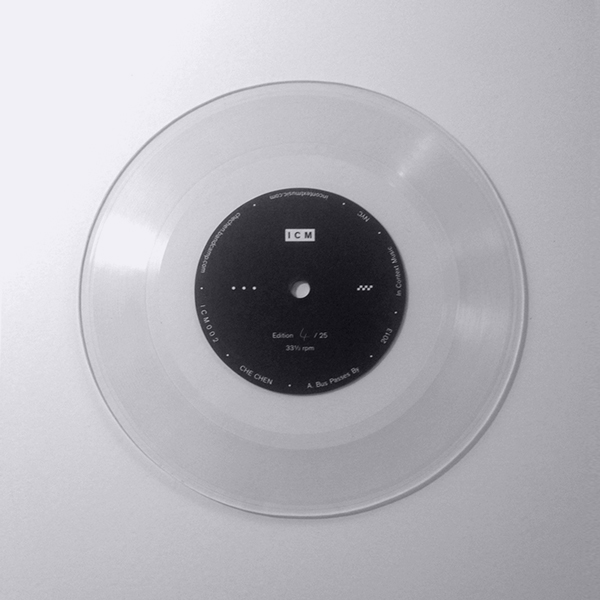
Che Chen was born in New Haven, CT and works at a cancer diagnostics company in Stonybrook, NY. For ICM002, he presents an analog tape composition focusing on his research and application of modified guitar techniques used in Mauritania.
Largely a self- taught musician, Che uses the violin, guitar and other musical and “non-musical” objects in works that explore his interests in perceptual phenomena and improvisation. Much of his solo work has consisted of improvisations based on the harmonic overtones of idiosyncratic tunings. Che’s interests in difference tones (closely tuned pitches that result in beating patterns), phasing, repetition, decay, the specialization of sounds, and the structural relationship between “audience” and “performer” have led him to use a variety of methods that include using analog tape delay systems, loops and manipulation, placing acoustic and electronic sound sources in various locations around the performance area, and generally eschewing the idea of “the stage”.
Che has toured in the US, Europe and Japan, presenting solo performances and collaborations with Jozef Van Wissem (Heresy of the Free Spirit), Robbie Lee, Chie Mukai, Tetuzi Akiyama and other spontaneous and ongoing configurations. As an anthologist, he has produced the artist magazine O Sirhan and runs his own label, Black Pollen Press, as an outlet for these and other endeavors. He currently plays guitar in the band 75 Dollar Bill.
PRESS
(1)
(1)
Both sides showcase some loose/wild electric guitar improvisation styles, lots of fretboard-tap squiggle and abrupt cuts in the recording to give it a disjointed feel, like the dancing chicken’s movements at the end of Stroszek, shot through with reminiscences of urban slush (side A) and exhausted roommates/neighbors (the flip). Chen’s journey here might only take you back to the starting point, but it’s a willful and excited trek, placing a premium not only on the musicianship that leads to this sorta fence-swingin’ elevational improv, but the sort of personality that wields it as well. Great efforts within! (Doug Mosurock, Still Single)
(2)
In Context Music’s jib is cut so clearly and concisely I couldn’t help but fall in love with it right away. Che Chen, of Pilgrim Talk fame, delivers ICM’s second release you should make sure you’re one of the lucky 25 people who get their hands on it. I’m having trouble placing this material on Chen’s timeline. Is this what those other releases sounded like? I’m thinking not, and I appreciate the change in direction...I could spend a few days decoding this one; and how! (Grant Purdum, Tiny Mix Tapes)
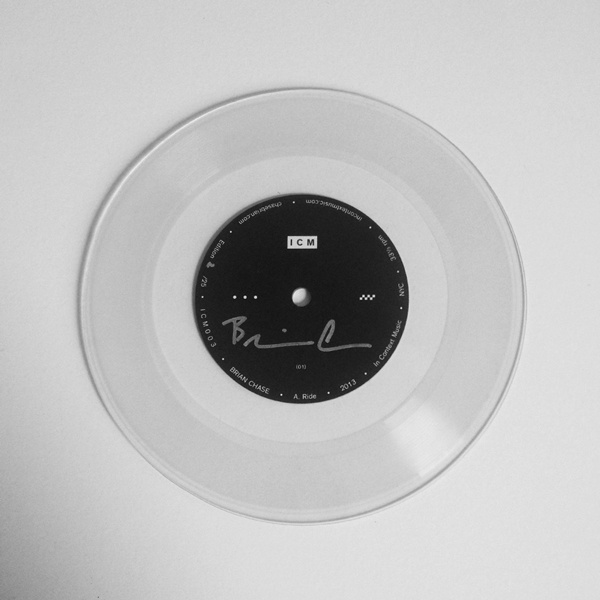
For ICM003, Brian Chase furthers his solo work and shares a growing ability to translate complex tuning theories into visceral and exciting pieces of music.
The two tracks, “Ride” and “Scratch” use as their sound source a single cymbal and drum respectively. On “Ride” the cymbal is playing a repeated pattern, imitating a groove played to seduce, causing the cymbal to ring with the shifting timbre of its tintinnabulation, a device to entrance. On “Scratch” the drum is played with a chopstick, imitating the motion of a needle playing a record, coaxing the drum to resonate with sustained tones of choir angels. Both tracks are processed with precise digital equalization according to the Just Intonation tuning theory, greatly bringing out the instruments’ natural acoustic overtones.
PRESS
(1)
Chase is best known as the drummer of the Yeah Yeah Yeahs, but his classical/conservatory side shouldn’t be understated. Here he works in a more experimental realm – the simple tapping of a ride cymbal (“Ride”) is filtered to reveal hidden harmonic/drone discoveries in the timbre of the metal, and similar metal percussives (or perhaps strings?) are bowed (“Scratch”) to unlock insanity-defense level peals of angelic anguish. (Doug Mosurock, Still Single)
(2)
Chase is an experimental mind ... His entry in the In Context Music series, on miraculously clear lathe-cut vinyl like the other limited-to-25 items in the line, is an exploration of deep-space sound manipulation that transcends mere method. By this I mean, you could never guess the source of these recordings unless you’d tried the same thing yourself ... A personal work that rewards intense listening. (Grant Purdum, Tiny Mix Tapes)

004
Nathan Liow & Angus Tarnawsky
Artifacts
7” lathe cut record (square)
Edition of 50 copies
2014
Nathan Liow and Angus Tarnawsky expose sonic phenomena associated with the vast physical network that enables the internet. Artifacts is a slowly evolving feedback conversation created by a live acoustic piano performance in West Space Gallery (located in Melbourne, Australia), broadcast immediately to NYC then returned and amplified through speakers and mixed with the existing performance. Within this process, inaudible sounds become apparent and distortion begins to erode and decay what is heard. The internet itself leaves a unique signature and becomes an organic third party working alongside the artists.
PRESS
(1)
Memories form drifting mental movies that blend together and bring heat to the face as you lean it against a bus window on a long nighttime ride. Nimble piano strokes and comps lift, dip, and flutter like angels, sending echoes bouncing off the walls. It’s a lonely feeling. It’s the opposite of, say, having a group of pianists play at the same time. Here, you take the playing of one, set it against itself, and watch as it spider-cracks outward like ice on the lake. Cold, crisp, and clinical; that’s how I like my context. Liow and Tarnawsky bend the corners of time effortlessly, turning a good idea into a great recording. (Grant Purdum, Tiny Mix Tapes)
Nathan Liow & Angus Tarnawsky
Artifacts
7” lathe cut record (square)
Edition of 50 copies
2014
Nathan Liow and Angus Tarnawsky expose sonic phenomena associated with the vast physical network that enables the internet. Artifacts is a slowly evolving feedback conversation created by a live acoustic piano performance in West Space Gallery (located in Melbourne, Australia), broadcast immediately to NYC then returned and amplified through speakers and mixed with the existing performance. Within this process, inaudible sounds become apparent and distortion begins to erode and decay what is heard. The internet itself leaves a unique signature and becomes an organic third party working alongside the artists.
PRESS
(1)
Memories form drifting mental movies that blend together and bring heat to the face as you lean it against a bus window on a long nighttime ride. Nimble piano strokes and comps lift, dip, and flutter like angels, sending echoes bouncing off the walls. It’s a lonely feeling. It’s the opposite of, say, having a group of pianists play at the same time. Here, you take the playing of one, set it against itself, and watch as it spider-cracks outward like ice on the lake. Cold, crisp, and clinical; that’s how I like my context. Liow and Tarnawsky bend the corners of time effortlessly, turning a good idea into a great recording. (Grant Purdum, Tiny Mix Tapes)